
THEYRON ENVIRONMENTAL
IMPACT REDUCTION
UAVs Environmental Footprint
It is our belief that widespread and meaningful reduction of environmental impact can most effectively be driven by a disruption of the underlying economics.
If an existing and necessary economic operation can be completed at a lower cost than current methods by a newly available technology, this can create a widespread imperative for change. This works to reduce the environmental footprint so long as the new technology is genuinely able to reduce the overall impact.
We are convinced that our system is capable, not only of revolutionising industrial UAV economics but also that it can provide a high level of environmental impact reduction for several existing UAV commercial operations.
Looking at aerial agriculture as an example. The industry is widespread and presently it is the largest user of hydro-carbon fuel where we could realistically have a positive impact.
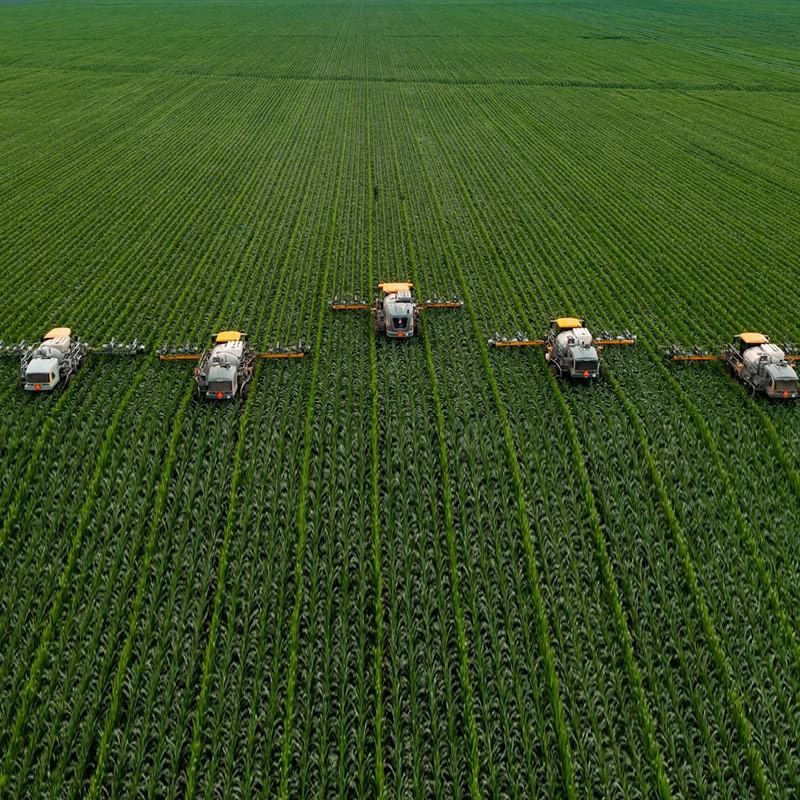
Commercial use of multirotor UAVs in agriculture is growing rapidly and is leading to a more streamlined operation of increasingly large and sophisticated UAV machines. All-in-one roadable fly-off/fly-on platforms have been developed to enable the transport of machinery, payload and staff along with minimal setup times to maximise daily payload rates.
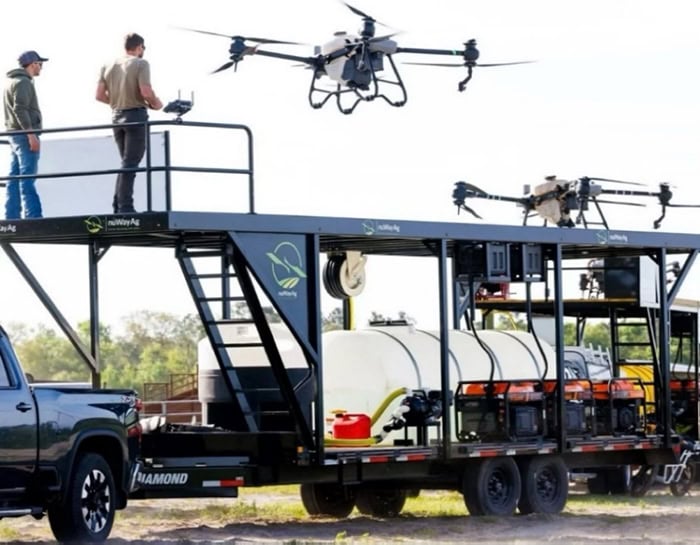
Presently, electric multirotor application tends to be more economical for smaller farm runs due to operational flexibility along with safer operation near obstructions such as power lines. For larger runs, manned helicopter application is presently more economical per payload application weight. This is for two main reasons.
Firstly, a turboshaft or piston-engine manned helicopter can carry a much larger payload and can apply this at a higher operational speed. As a result, manned helicopters have a far higher daily application rate that is more than able to compensate for higher fixed operations costs, when compared to a multirotor operation.
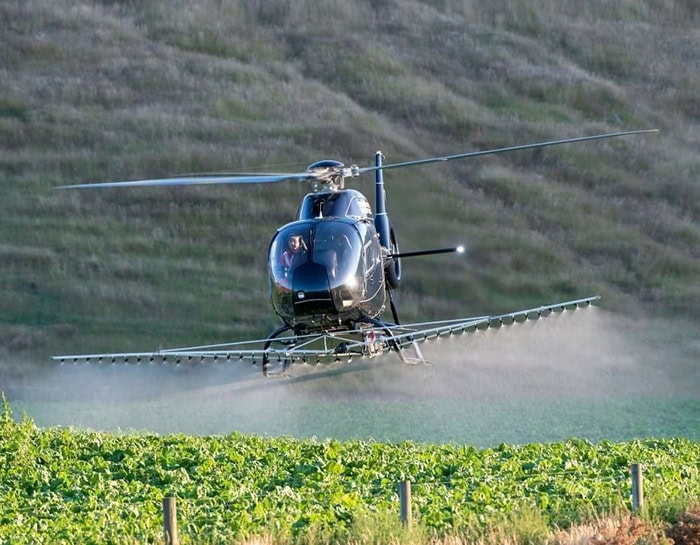
Secondly, operations staff numbers per daily payload rate are smaller for a manned helicopter operation due to the sheer volume of applications. Currently, a greater proportion of a multirotor operation’s daily costs are in operations staff.
To allow UAV’s to become more economical than manned helicopters for bulk agricultural applications, daily payload rates along with operations staff numbers need to be improved.
Theyron’s system can be configured to accomplish this.

1 – Daily payload rates:
The Theyron airframe system can be configured to a low disc-loading, ready-to-fly-as-roadable agricultural platform with a useful load, in excess, of battery or fuel, of over 200kg.
Also, higher operational speeds than an agricultural multirotor are attainable. Increased useful payload and speed combine to provide a higher daily payload rate.
2 – Staff numbers:
A considerable proportion of a multi-rotor operation time is taken up with manual battery change and payload refilling on the landing platform during every flight cycle. This is exacerbated by the larger number of flight cycles required due to the comparatively small payloads of even the largest available UAV machines.
An inherently better vehicle endurance allows our platform the potential for the rapid development of fully autonomous flight deck payload refilling using robotic auto-filling systems currently available and in commercial use in other areas. Automated refilling has the potential to reduce flight cycle times and operations staff numbers.
Remote station piloting is presently being rolled out for UAV and its potential for multi-vehicle management would apply well to the relatively simple and robust Theyron package. The larger individual payload potential would create further labour-saving economies here also.
Electric Versus Internal Combustion
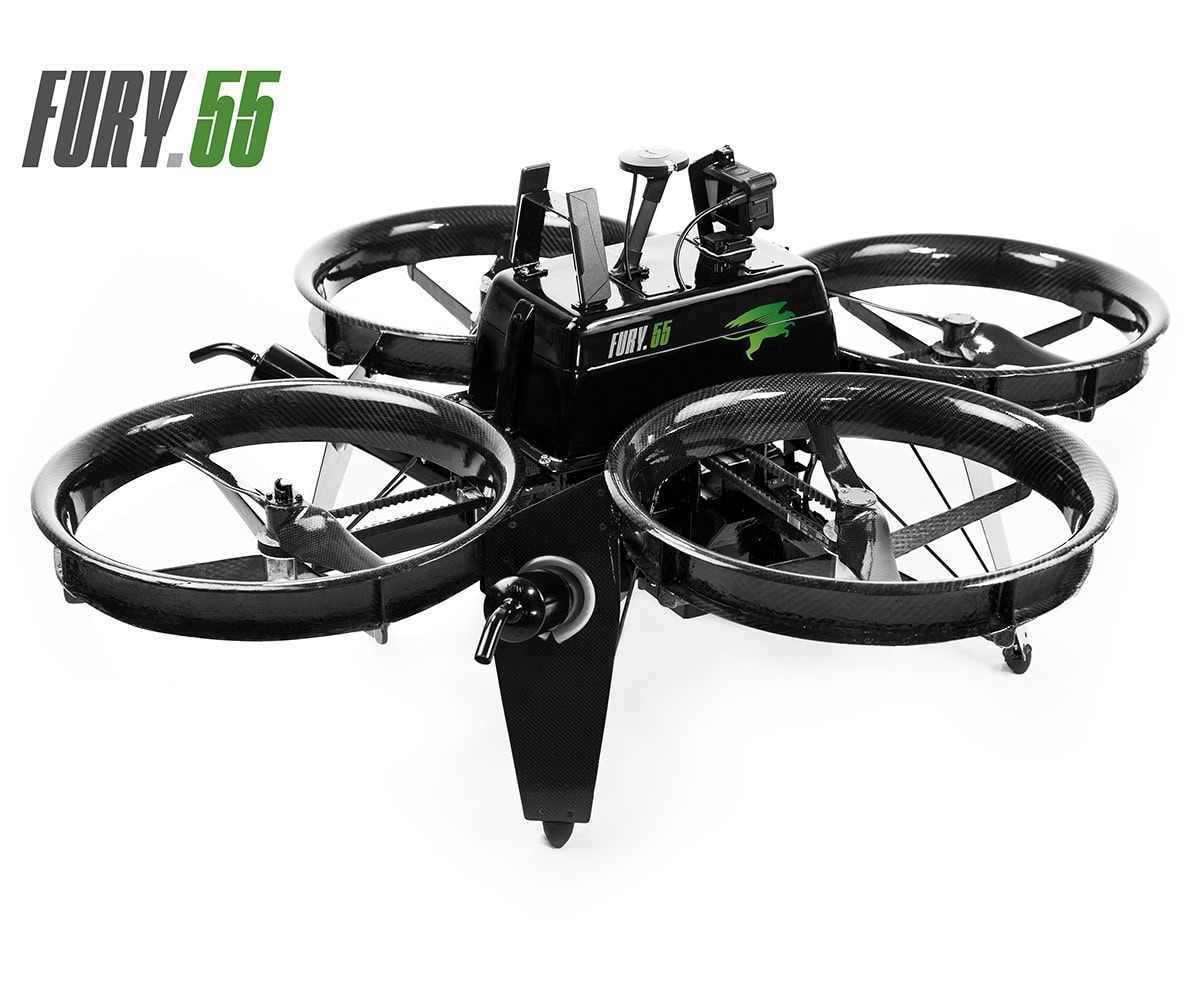
Electric UAV is sometimes presented as ‘zero emission’. This view is somewhat of an oversimplification and is holding back the potential of UAV’s to reduce emissions at the bulk end of the scale. This is because on their own electric UAV’s, are presently not capable of replacing manned helicopter agriculture entirely due to the real-world logistical situation of most rural agricultural operations.
The combined use of smaller electric multirotor UAV’s along with larger Theyron type UAV’s and taking advantage of streamlining technologies such as EFI powerplant options, automated refilling and autonomous flight, combined with remote-location piloting, has the potential to completely replace manned helicopter agriculture by becoming economically more viable.
At the same time, the fuel footprint per daily payload rate can be drastically reduced for the following two reasons.
1 – Worldwide, the application of agricultural payload by manned helicopter operations, is being carried out overwhelmingly by turboshaft-powered machines. This situation is unlikely to change. The reasons are primarily economic due to the higher load-carrying ability of a turboshaft helicopter against fixed operations costs.
Also, a high proportion of helicopters used in agriculture are dual-use, that is the same machines are also used seasonally for non-agricultural tasks. This means that helicopters in agricultural use, necessarily reflect the overall predominance and availability of turboshaft machines.
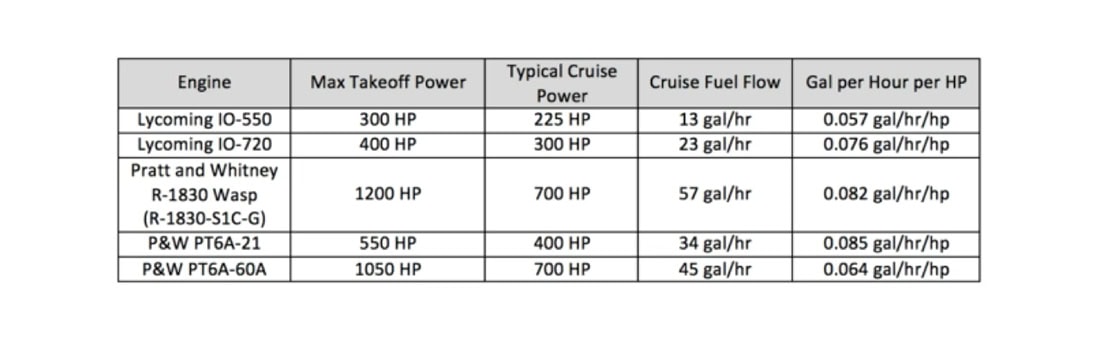
At the low operating altitudes and smaller power requirements common to agricultural operations, a turboshaft helicopter typically uses 30-40% greater fuel weight per power output than a piston engine-powered machine. Fuel use per payload application weight is also adversely affected by the comparatively low useful load percentage that a manned turboshaft helicopter can apply as payload, relative to the overall aircraft MTOW.
This situation is further exacerbated by the fact that turboshaft powerplants have an inherently lower fuel-burn efficiency than is possible for a piston engine. As a result, turbine helicopter operations necessarily have a higher level of harmful emissions per weight of fuel consumed.
2 – Due to existing logistics and the increasing size and power requirements of agricultural UAV’s, the majority of electric-UAV rural operations are currently forced to use either diesel or petrol electricity generators to power battery charging and ancillaries during onsite operations.
This ad-hoc method of operation results in a very inefficient, compounding electrical loss chain. The combined result is that agricultural UAV operations presently consume more fuel per applied payload weight than manned helicopter operations do.
Electrical power generation losses at the generator are multiplied together with battery charging heat losses and further with discharge losses, and again where electrical energy is converted back into kinetic energy through the ESC’s and rotor motors of the UAV.
This situation is further exacerbated by the higher staff numbers per daily payload rate of multirotor UAV operations. In practice, this translates to a higher overall fuel use by ground support vehicles relative to daily application rates.
Leveraging EFI and Biofuel Options
Considerable advances have been made in biofuel and engine technology that can be directly leveraged for use with the Theyron system.
1 – Second and third-generation Bioethanol fuels are now available with ethanol contents of up to over 90%. Commercially available Bioethanol derivatives are produced primarily from lignocellulosic and non-food, waste feedstocks and are adapted as an alternative fuel for gasolene-type engines.
The Embraer EMB202A fixed-wing aircraft appears to be the only agricultural aircraft currently certified for commercial use with Bioethanol fuel. The Bioethanol variant of the Embraer has been in widespread economic use in Brazil for 20 years.
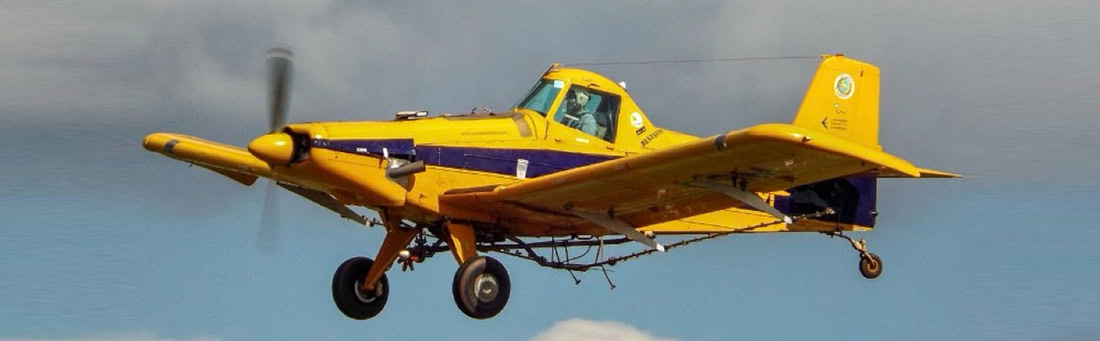
The EMB 202A is a case in point of a positive and lasting environmental development that was driven primarily by the underlying economics. Brazil has been an early adopter of Bioethanol fuel and is currently the second-largest producer in the world. The availability of cheaper Bioethanol fuels in Brazil originally led to its unofficial use in the Embraer by several commercial operators.
This situation ultimately drove the development and certification of the Embraer 202 series as a Bioethanol-certified option. More economic and producing 7% more power, the Bioethanol variant is said to currently make up over 80% of new sales of the 202 series in Brazil and remains in widespread use.
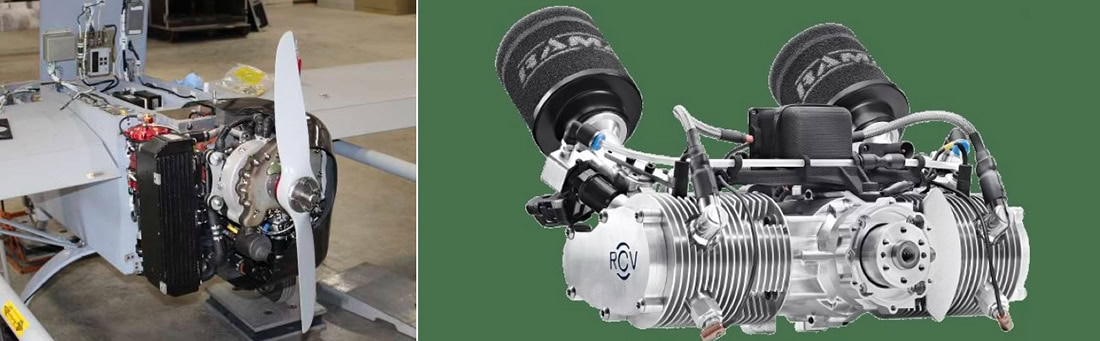
Increasing use of internal combustion engines in helicopter and fixed-wing type UAV’s, has led to considerable development in UAV-specific engine technology. UAV engine developers are producing an increasingly wide range of certified rotary and piston engines at competitive pricing.
UAV-specific ancillaries such as starter generators and electricity management systems, along with EFI and engine management systems capable of easy integration into commonly used UAV flight controllers are readily available.
The Availability of mature, aviation-certified powerplant technologies able to be applied directly to our system, has the potential to greatly reduce future development and production costs. Electronic Fuel Injection systems along with flight-controller-integrated engine management systems, also allow for the efficient use of various grades of Bioethanol fuel types.
2 – Sustainable Aviation Fuel, is a commercially available alternative to Aviation Kerosene or Jet fuel, also known as Heavy-Fuel. Developed primarily as an environmentally sustainable alternative fuel for commercial jetliner aviation, SAF fuel is becoming increasingly widely available commercially.
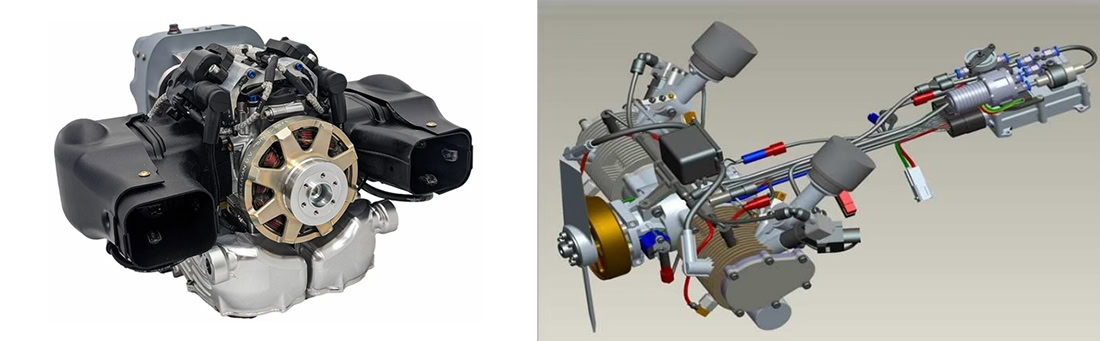
UAV-certified engines specifically developed for Heavy-Fuel operation are now commercially available. Heavy and SAF-type fuels have a higher energy density than spirit or gasoline-type fuels. Heavy-fuel EFI engines operating on Jet and SAF-type aviation Kerosene, use a lower fuel-weight per given power output than gasoline types.
This creates further potential for economic, along with range and endurance advantages, combined with further potential for environmental footprint reduction.
Macro-Scale Footprint Reductions – Inspection And Surveying
Huge advances are being made in UAV surveying and asset monitoring capabilities. UAV-based Lidar and photogrammetry, combined with AI-assisted automated 3D scanning software are becoming indispensable tools in exploration and mining, along with infrastructure development and asset management.
Secure, infinitely long-range BVLOS connectivity and multi-vehicle remote station piloting combined with AI and machine-vision-assisted automated flight control is now a reality. These capabilities are being employed in a wide number of industries and have made long-range UAV operation increasingly possible.
Presently, the single biggest factor limiting the wider rollout of long-range UAV surveying and inspection is the endurance limitation of available VTOL UAV air platforms. As a result, large numbers of long-range asset inspections are still being carried out using manned turboshaft helicopters.
Large-scope UAV operations using multi-rotors, often need to be conducted using ad-hoc and time-consuming methods such as vehicle transport between multiple fly-off points around the overall operations area. UAV inspections, of offshore windfarm installations are necessarily conducted from support vessels due to the endurance and range limitations of the available air platform hardware.
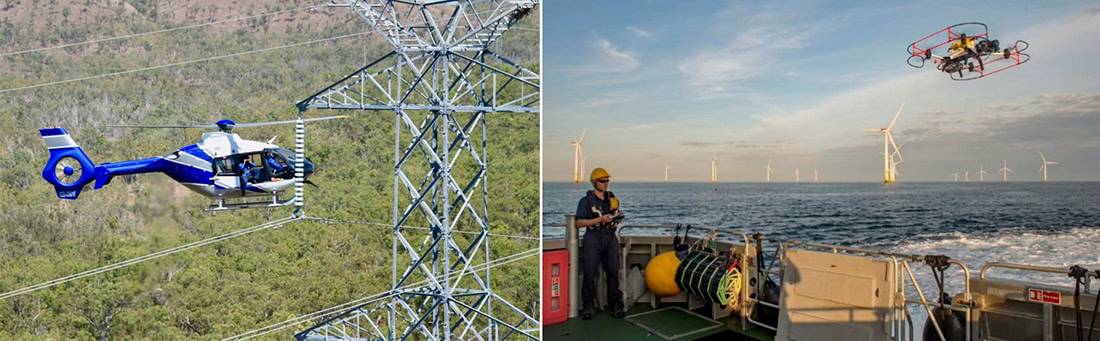
Theyron’s robust and effective operating system can be configured for use in long-range, austere and windy operating environments. With a cost and utility close to that of the speed-controlled multirotor, our system has the potential to revolutionise the underlying economics of a wide number of operations presently still being carried out by manned helicopter aviation.
Configurable to ranges of several hundred kilometres and flight times of several hours, the Theyron system has the physical and economic potential to effectively replace helicopter aviation in a large number, of wide-scope and long-range asset inspection and surveying operations.
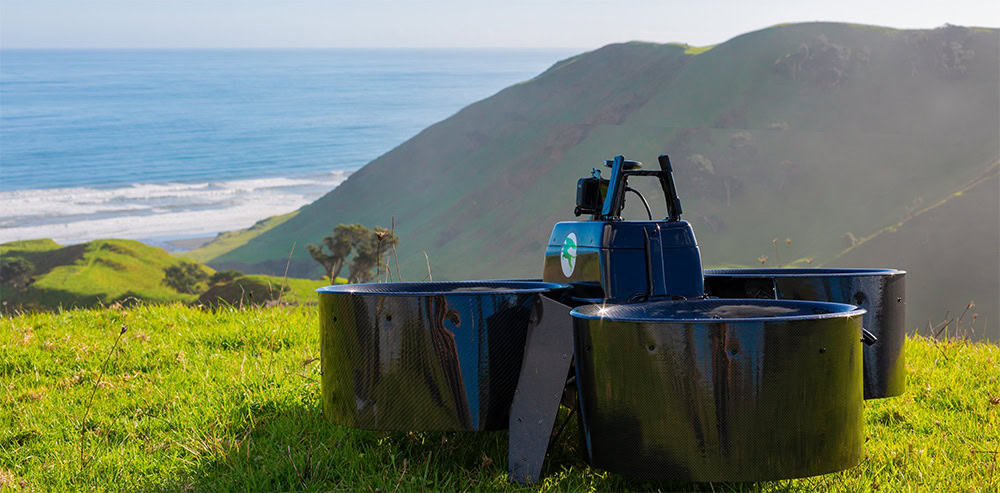
Theyron’s system also has the potential to drastically reduce the environmental footprint. Where we can directly replace a manned helicopter inspection or surveying operation, our system would potentially consume just 1-2% of the fuel use of a turboshaft machine.
Where competing with an existing multirotor operation, our system has the potential for a much greater range and daily coverage, along with the ability to reduce operations staff numbers and support vehicle footprints
.
Explore how our innovative rotor control system can transform your UAV operations.

Inquire:
* Required Fields.
Before contacting us via the portal, please ensure that you have thoroughly read the material presented on our website.